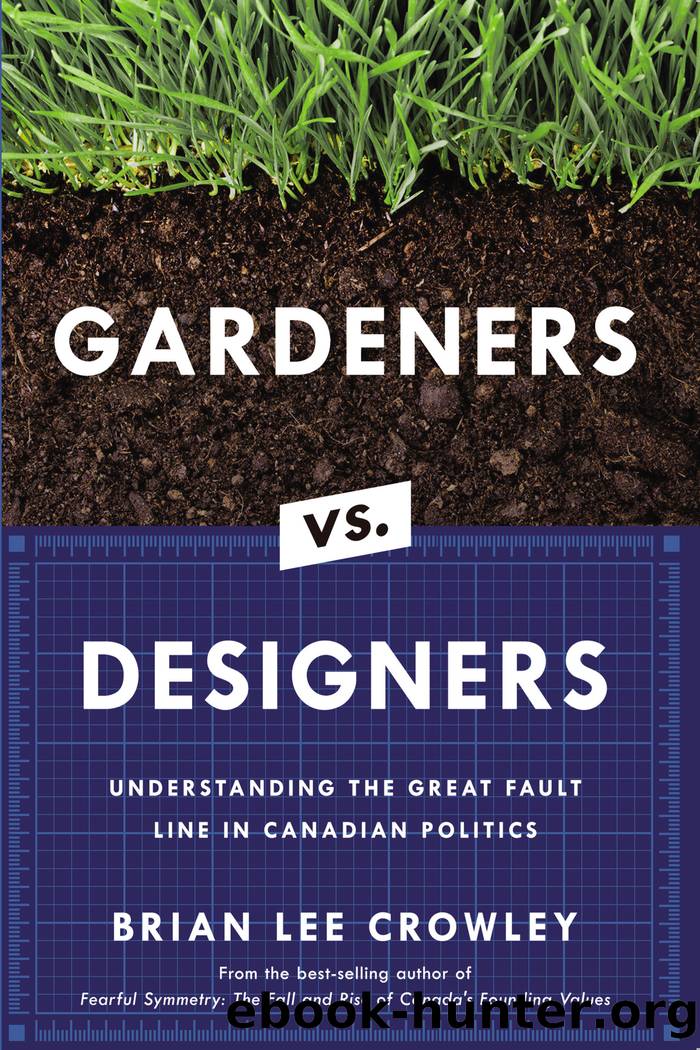
Gardeners vs. Designers: Understanding the Great Fault Line in Canadian Politics by Brian Lee Crowley
Author:Brian Lee Crowley [Crowley, Brian Lee]
Language: eng
Format: epub
ISBN: 9781989555354
Google: BuK9zQEACAAJ
Amazon: B08KWKXPZK
Barnesnoble: B08KWKXPZK
Goodreads: 55741711
Publisher: Sutherland House Inc
Published: 2020-09-23T00:00:00+00:00
CHAPTER VII
Gardening for the planet
WHEN TALKING ABOUT THE environment there is an inescapable question: are human prosperity and well-being an illusion, bought at the expense of nature? To those who answer in the affirmative, human beings add nothing to the world and subtract everything. But, however much this answer may appeal to the apostles of environmental doom and gloom and the opponents of the oil sands and fish farming and pipelines and biotechnology, it is wrong.
There is something deeply rooted in the human psyche that believes that good fortune is the product of undeserved luck, and that we will be punished tomorrow for enjoyment and success today.
This belief has been particularly prevalent in the post-Enlightenment era, where it has advanced in lockstep with the very different reality that human intelligence and ingenuity have consistently and repeatedly unlocked technological and scientific wonders that have raised the standard of living of each generation compared to its predecessor while vastly increasing the ability of human society, in partnership with nature, to support larger numbers of people.
Yet Thomas Malthus earned economics the nickname âthe dismal scienceâ in the eighteenth century by arguing that the population was growing faster than the food supply. He predicted mass starvation.97
Again in the 1970s, the Club of Rome predicted massive shortages of natural resources due to overconsumption and overpopulation with disastrous effects on human health and material well-being.
In 1980, the Global 2000 Report to the President wrote: âIf present trends continue, the world in 2000 will be more crowded, more polluted, less stable ecologically, and more vulnerable to disruption than the world we live in now . . . Despite greater material output, the worldâs people will be poorer in many ways than they are today.â98
A few years ago, the front page of the Halifax Herald claimed that the resources of four more planets would be needed to maintain us at our current levels of consumption. We were exhorted to give up cars for bicycles.
And just last year Greta Thunberg cried out in anguish that we should âbelieve the scientistsâ who were predicting, according to her, that the planet would be unfit for human habitation within a few short years because of climate change.
Time and again, people have looked at growing human prosperity, improving health and population increase and told us that we were living in a foolâs paradise, that it obviously couldnât continue, that our prosperity was at the cost of others, such as the poor or future generations, and that we would pay the price for our irresponsible wickedness.
Weâre still waiting.
The reason weâre still waiting, why the ecosystem hasnât collapsed, why we are still successful in feeding ourselves, why incomes are rising and health status improving around the globe, is that the doomsayers have completely misunderstood the way the world works.
Of all their misunderstandings, two stand out. They donât understand what natural resources are. And they donât understand that the greatest natural resource of all is the human mind.
It may be popular, but it is quite incorrect
Download
This site does not store any files on its server. We only index and link to content provided by other sites. Please contact the content providers to delete copyright contents if any and email us, we'll remove relevant links or contents immediately.
| Arms Control | Diplomacy |
| Security | Trades & Tariffs |
| Treaties | African |
| Asian | Australian & Oceanian |
| Canadian | Caribbean & Latin American |
| European | Middle Eastern |
| Russian & Former Soviet Union |
The Secret History by Donna Tartt(19088)
The Social Justice Warrior Handbook by Lisa De Pasquale(12190)
Thirteen Reasons Why by Jay Asher(8909)
This Is How You Lose Her by Junot Diaz(6886)
Weapons of Math Destruction by Cathy O'Neil(6279)
Zero to One by Peter Thiel(5801)
Beartown by Fredrik Backman(5754)
The Myth of the Strong Leader by Archie Brown(5507)
The Fire Next Time by James Baldwin(5444)
How Democracies Die by Steven Levitsky & Daniel Ziblatt(5218)
Promise Me, Dad by Joe Biden(5153)
Stone's Rules by Roger Stone(5087)
A Higher Loyalty: Truth, Lies, and Leadership by James Comey(4963)
100 Deadly Skills by Clint Emerson(4925)
Rise and Kill First by Ronen Bergman(4788)
Secrecy World by Jake Bernstein(4753)
The David Icke Guide to the Global Conspiracy (and how to end it) by David Icke(4717)
The Farm by Tom Rob Smith(4509)
The Doomsday Machine by Daniel Ellsberg(4490)
